Atlas Roof Repair in East Los Angeles: A Homeowner’s Guide
Atlas roof repair in East Los Angeles comes down to one thing most homeowners don’t realize until it’s too late: matching the exact product line, the exact color, and ideally the exact granule batch. Get it wrong and the patch looks fine for about six months, then the sun does what the East LA sun does and you’re left with a two-tone roof that advertises the repair to every neighbor on the block. We’ll walk through what a proper Atlas repair actually requires, what it costs, and when you should skip the patch and think about replacement. If you’d rather not spend your Saturday on a ladder, call (877) 752-3460 for a free estimate.
Key Takeaways
- Atlas makes distinct product lines (StormMaster, Pinnacle, GlassMaster) that are not interchangeable, even within the same color family.
- Granule batch matching matters in East Los Angeles because UV exposure fades mismatched shingles at different rates.
- Atlas’s Scotchgard algae protection is integrated into the granule coating; repairing with non-Scotchgard shingles breaks the visual and protective continuity.
- Warranty validity after a partial Atlas repair depends on the contractor following Atlas’s installation specs for flashing, starter strips, and fastener patterns.
- Atlas repair in East LA typically runs $350 to $750 for a small patch; a full Atlas re-roof starts around $9,000 and climbs based on product line and access.
Why Atlas Shingles Have a Following in East Los Angeles
Atlas Roofing Corporation has been manufacturing shingles since 1982, but what earned them a loyal base in Southern California is the StormMaster line. It’s a heavier shingle, closer to what the industry calls a “high-definition laminate,” and it holds up better to the relentless UV of an East LA summer than entry-level three-tabs. Pinnacle is the mid-tier Atlas product, plenty good for most homes, and it carries the same algae-resistance treatment as the premium lines.
What most homeowners don’t know is that Atlas applies its Scotchgard Protector to the granule surface at the factory. That’s not a coating you can reapply after a repair. So when a section of your roof gets replaced, the new shingles need to be Scotchgard-treated Atlas product, not just something that looks close from the street. Otherwise you’ll see the difference within a year or two, especially on south-facing slopes.
Over in neighborhoods like El Sereno, Boyle Heights, and City Terrace, we see a lot of homes that were re-roofed in the early 2000s with either Atlas or GAF. The Atlas roofs age differently. They hold their granule surface longer in the intense sun, which is exactly why a repair that ignores product-line matching stands out so badly.
The Granule Batch Problem Nobody Explains
Roofing granules are crushed stone coated with ceramic color. Manufacturers run batches continuously, and each batch gets a lot number. Two batches of the same “Weathered Wood” or “Driftwood” color can differ subtly in tone, sparkle, or reflectivity. On a full re-roof, that’s invisible because the whole roof comes from the same batch. On a repair, it’s the whole story.
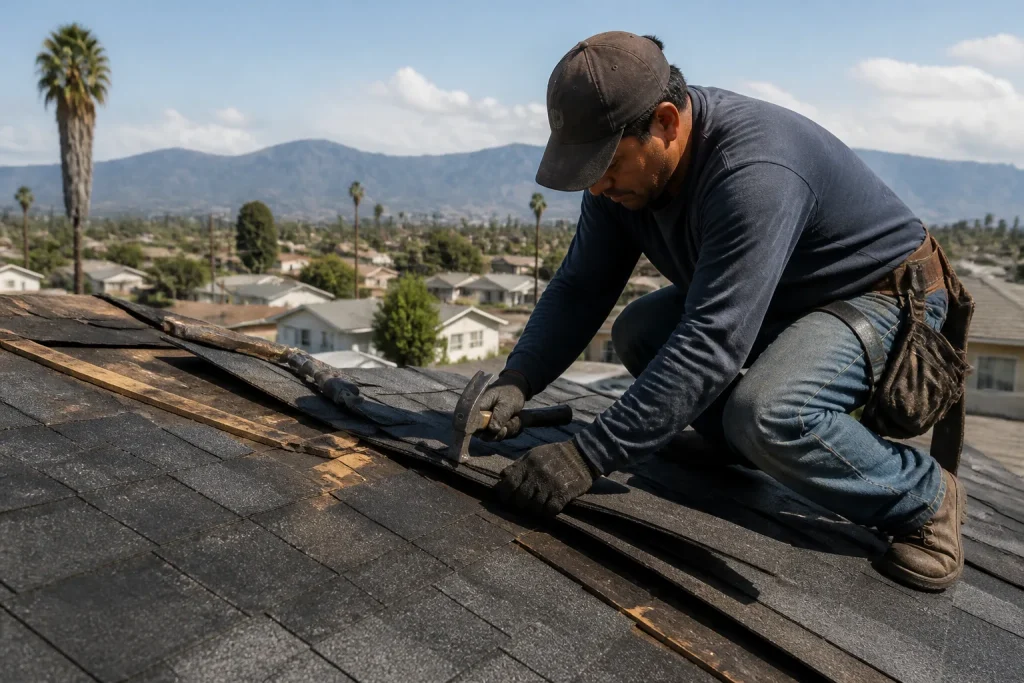
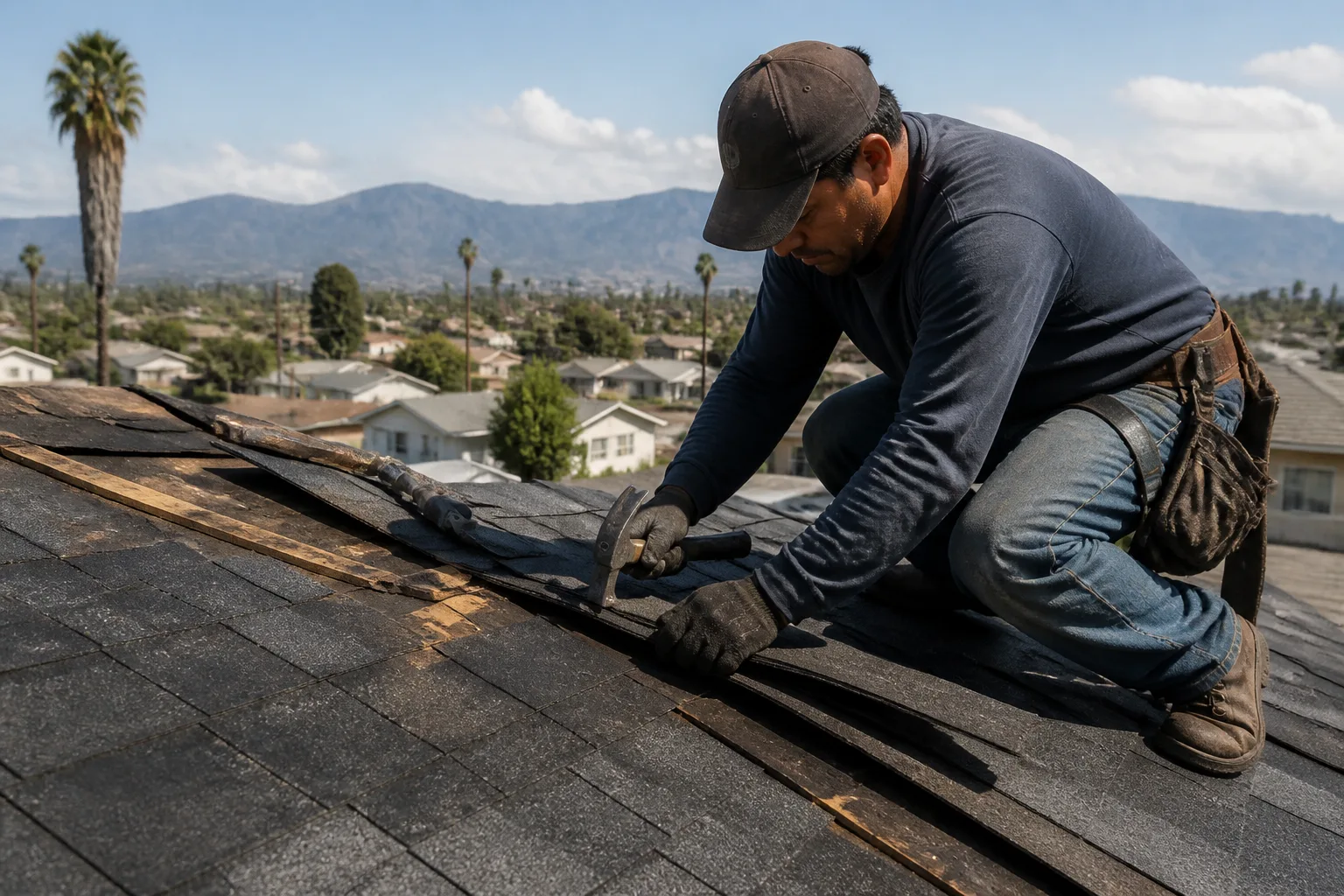
A contractor who grabs “whatever Atlas is in the supply house” is gambling. The shingle might be the right product line and the right color name, but if the granule batch is six months older or newer, the repair reads as a patch once the angle of the sun changes. We’ve pulled replacements off homes in East Los Angeles where the repair was done correctly in every technical sense, only for the homeowner to live with a rectangle of slightly-different brown for a decade because nobody thought about batch consistency.
This is one reason we stock multiple Atlas product lines and check batch and date codes before any repair. It’s a small step. Missing it turns a $500 repair into a visible defect that’s actually harder to sell than a leak.
What an Atlas Repair Actually Requires
Atlas publishes installation specifications for every product line, and those specs apply to partial repairs just as much as full installations. The critical details:
- Flashing: Atlas specifies metal flashing at all valleys, sidewalls, chimneys, and skylights. A repair that doesn’t re-seat or replace compromised flashing violates the spirit of the warranty and will leak again at the same spot.
- Starter strips: On the eaves and rakes, Atlas calls for a specific starter course that locks the first row of shingles down. Cut corners here and wind-driven rain gets under the field on the next Santa Ana event.
- Fasteners: Atlas requires a minimum number of fasteners per shingle and a specific placement pattern. The classic East LA repair mistake is a hand-nail job with the wrong nail count, which shows up as lifted tabs within two years.
- Nailing pattern on repairs: When you’re weaving new shingles into an existing field, Atlas’s fastening schedule still applies. That often means removing several courses above the damage to lay the patch correctly, not just sliding one shingle under and calling it done.
If this sounds like a lot of fuss over what looks like a simple shingle swap, that’s the point. The technical failures that cause recurring leaks in East Los Angeles roofs are almost always the invisible ones: the fastener that’s a quarter-inch too high, the flashing that wasn’t replaced because it “looked fine,” the starter strip that got reused.
That’s the honest difference between an $80 handyman patch and a repair that holds. We happen to do the latter, but this guide is about helping you recognize it either way. For more on our repair scope specifically, see our Roof Repair in East Los Angeles page.
Scotchgard Protector and the East LA Climate
Atlas’s algae protection matters differently in Southern California than it does in, say, Georgia or Florida. Here, the enemy isn’t humidity-fed streaking. It’s UV degradation. The Scotchgard treatment on Atlas granules slows color fade, but more importantly, it’s part of how Atlas controls granule-to-asphalt adhesion. UV breaks down the asphalt coating, granules release, and the shingle loses its protective surface. The Scotchgard layer is one part of Atlas’s system against that breakdown.
So when a repair patch uses untreated Atlas shingles, you get two failure timelines running side by side. The field of the roof is protected per its original spec. The patch is not. That creates an aesthetic problem within the first or second year and a durability problem within five.
There’s no way to field-apply Scotchgard. It’s embedded in the granule coating during manufacturing. The only correct fix is specifying Scotchgard-treated Atlas product for any Atlas repair. This is a detail most East Los Angeles homeowners don’t ask about, and most contractors won’t volunteer, because it means sourcing the right product rather than pulling whatever’s closest to hand.
In our material-agnostic position, we carry multiple Atlas lines with Scotchgard because we’ve seen what happens when a repair ignores it. We also carry IKO and Tamko for homeowners who want a different performance profile entirely, which is a decision worth making consciously rather than inheriting from whoever shows up.
Warranty and Contractor Certification: Why It Matters for Repairs
This is where Atlas differs from some other manufacturers in ways that directly affect an East Los Angeles repair. Atlas offers the Atlas Signature Select warranty program, which provides enhanced coverage when the roof is installed by a contractor who meets Atlas’s certification requirements. We are not going to claim certification here because that’s a specific, documented status we don’t misrepresent. What we can tell you is how to verify it for any roofer you’re considering:
- Ask the contractor for their Atlas contractor ID or proof of participation in the Atlas contractor program. If they can’t produce it in writing, they don’t have it.
- Check Atlas’s website for a “find a contractor” tool and confirm the company is listed.
- Ask whether the repair will be documented with Atlas for warranty registration purposes. A legitimate repair can be registered with the manufacturer, especially if the original roof was registered.
- Request the specific Atlas installation spec sheet for the product line being used, and confirm the repair will follow it.
When a partial repair uses Atlas product installed outside spec, Atlas’s position is straightforward: the workmanship issues are the contractor’s risk, not the manufacturer’s. That’s not an Atlas-specific stance, it’s true across the industry, but homeowners often assume any “Atlas roof” has Atlas standing behind it. The warranty covers the product. The contractor covers the installation. Choose one who treats the second part seriously.
This is also a key factor if you’re buying or selling a home in East Los Angeles with an existing Atlas roof. A documented, registered repair preserves some warranty value. An undocumented handyman patch doesn’t.
Atlas Repair Costs in East Los Angeles vs. Full Re-Roof
We’ll give you honest numbers based on what we see across East LA, from Boyle Heights up through El Sereno and Lincoln Heights:
| Scope | Typical Cost in East Los Angeles | Notes |
|---|---|---|
| Small patch (under 10 shingles) | $350 to $550 | Includes granule matching and proper fastening. |
| Repair with flashing replacement | $600 to $1,200 | Valley, chimney, or sidewall flashing rework. |
| Repair with decking repair | $800 to $1,800 | If moisture has damaged the plywood or OSB. |
| Full Atlas re-roof (1,200 to 1,500 sq ft) | $9,000 to $14,500 | Varies by product line, tear-off, access, local permitting. |
Those are real ranges. The most important fork in the road is deciding whether a repair is even the right move. A roof with one leak site on an otherwise sound field? Repair it. A roof with soft decking in three places, granule loss on every slope, and repeated repairs in different spots? That’s a replacement waiting to be planned, and patching it again just moves money onto a roof that’s already past its service life.
When we say “repair when repair is right, replace when it’s not,” that’s the decision trap we’re trying to help East Los Angeles homeowners avoid. If you’re unsure which side of that line your roof is on, the inspection is the right first step. We offer Roof Inspection in East Los Angeles as a standalone service, not a sales call in disguise, because the honest answer depends on what’s actually under the shingles.
And if you’re weighing materials for a future replacement, see ourRoof Replacement in East Los Angeles page for a breakdown of what different product lines cost and where Atlas fits among the options.
When to Call a Pro (and When to Leave the Ladder Alone)
Roof work on any slope is genuinely dangerous. We say this without drama: falls from single-story roofs kill people every year in Southern California. If your East Los Angeles home has any pitch beyond nearly flat, if the damage is anywhere near the edges or eaves, or if you can’t identify exactly what’s wrong from the ground, call a professional. The cost of a repair is a fraction of the cost of an ER visit, and we’d rather lose the job than read about it.
That said, here’s what a homeowner can safely do from the ground:
- Look for granule accumulation in gutters and downspout outlets. Granule loss equals shingle aging.
- After a heavy rain, inspect the ceiling for any new staining, including small spots that dry quickly.
- Look at the roof from the street at two different times of day. Repairs and mismatched patches show up most clearly when the sun is low and raking across the surface.
- Check around vents, skylights, and the chimney from the ground with binoculars. That’s where 80% of East LA leaks start.
If any of these turn up something, that’s your signal to get an objective inspection before water damage spreads into framing or insulation. A $400 inspection beats a $4,000 drywall and decking job.
The Bottom Line
Atlas makes a solid shingle for the East Los Angeles climate, but a roof is only as good as the details around the repair. Matching the product line, the granule batch, the Scotchgard treatment, and the installation specs is what separates a patch that disappears from a patch that becomes a conversation with every neighbor.
If you’re in East Los Angeles and need an honest read on an existing Atlas roof, Sunrise Roof Repair offers free estimates. We inspect first, recommend second, and carry the material breadth to match what’s already on your roof without steering you toward a bigger job than you need. Call (877) 752-3460 before the next rain hits.
Frequently Asked Questions
Yes, in most cases. Matching requires identifying the exact Atlas product line, color name, and ideally the granule batch from the original installation. A contractor who stocks Atlas product and checks date codes can make a repair that doesn’t visually stand out. Call (877) 752-3460 and we’ll tell you honestly if your existing roof can be matched.
Most small Atlas repairs in East Los Angeles run between $350 and $550. Repairs involving flashing, decking, or larger damaged sections run $600 to $1,800. The exact number depends on scope, access, and what’s actually under the damaged area. Estimates are free, so you’ll know before you commit.
An Atlas repair that follows Atlas’s installation specs, uses the correct product line, and is documented appropriately should not void the warranty. A repair that cuts corners on flashing, fastening, or product selection shifts liability to the contractor. That’s why it matters who does the work.
A properly executed Atlas repair on an otherwise sound roof should last the remaining life of the surrounding shingles, typically 10 to 20 years depending on the age and condition of the field. If the surrounding roof is nearing end of life, no repair buys much time. Call (877) 752-3460 for a free assessment if you’re not sure which situation you’re in.
Written by the team at Sunrise Roof Repair, serving East Los Angeles since 2015.
Need Roofing Help?
Call Sunrise Roof Repair — licensed & insured, here with fast after-hours help in Walnut Park.
(877) 752-3460